Not a sales pitch — a real picture of daily life on Sausalito's floating home docks, from the morning routines to the community culture to the practical realities no one tells you about.
“I tell every buyer: the parking will bother you for three weeks and then you won’t notice it. The view will never stop being extraordinary. Those are the actual numbers.”— Paul Bergeron
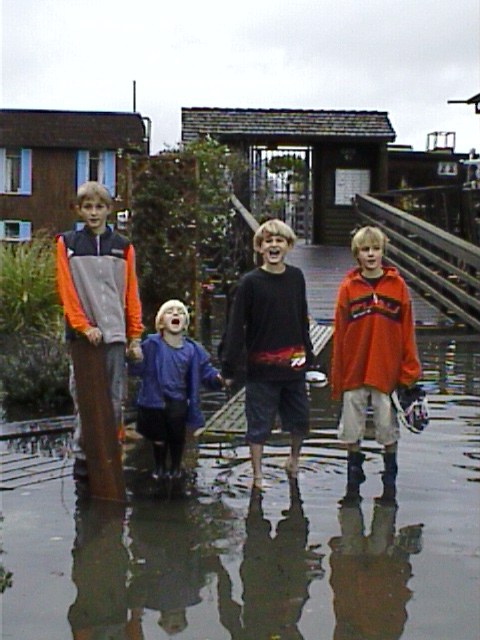
King Tides on East Pier. Read: Raising 4 Houseboat Boys →
Paul Bergeron raised four boys on the Sausalito docks. His kids never had a grass backyard — what they had was Richardson Bay, and they learned to fish, read the tide, and name the birds before most kids their age knew how to ride a bike. Growing up on floating homes means growing up close to something real.
Before the coffee is finished, you're aware of the water. Not the sound of traffic, not a neighbor's alarm — the water. In winter it might be the gentle slap of small waves against the hull from a passing ferry. In summer, Richardson Bay in the early morning is so still it looks like hammered glass, and the only movement is a brown pelican landing on the dock railing outside your kitchen window.
This is the thing people who have never lived on the water struggle to understand about floating home life in Sausalito: the water isn't just a backdrop, it's a constant, living presence. Your home moves with it — imperceptibly most of the time, noticeably during the occasional winter storm. You feel the tide without thinking about it. You orient your day differently than people who live on land.
Paul Bergeron has been waking up to this view since 1984. "There is no morning that's the same," he says. "The light changes every day. The water changes. After forty years, I'm still not bored looking at it."
Mornings on the docks have a rhythm. Neighbors nod on their way to the parking lot. Someone has left fresh tomatoes on the communal table at Gate 5 (this happens more than you'd think). The sound of a boat engine starting up drifts across the water. Kids on the dock-adjacent homes head off to school. It's the quietest form of neighborhood life you can find this close to San Francisco.
In a traditional neighborhood, you might wave to a neighbor once a week. On the docks, you walk past each other's homes every time you go to your car. There's no avoiding community life when you share a gangway — which is either the best thing about floating home living or a reason it's not for you, depending on your personality.
For most people who choose to live here, it becomes one of the things they love most. The floating home community in Sausalito has an unusually high rate of long-term residents — people who arrived, found their people, and simply didn't leave. Roman Bergeron grew up knowing neighbors who had been on the same dock for 20 or 30 years. On the Bergeron family's own dock, many of those neighbors are still there — people who have called the same slip home for three decades or more.
Each dock has its own character. Gate 5 has regular impromptu gatherings — someone starts playing guitar on the stern deck and within an hour there are twelve people there. Gate 6½ tends toward quieter, more intentional socializing. Liberty Dock has a community garden and potluck tradition that's been running for years. These cultures are real and persistent, and they're worth understanding before you buy — because you're not just buying a home, you're joining a specific community within a community.
Richardson Bay is one of the most ecologically rich estuaries in California. It's a protected area, home to migratory birds, harbor seals, and a diverse fish population — which means that when you live on the floating home docks, you are living in the middle of an active wildlife habitat.
This is not a metaphor. Harbor seals haul out on floating platforms near the docks. Brown pelicans cruise past at eye level when you're standing on your deck. Great blue herons hunt in the shallows at low tide, so still they look like sculptures. In winter, thousands of scaup, bufflehead, and other diving ducks winter in the bay directly outside your window.
For people who love the natural world, this is extraordinary. For people who expected the standard Bay Area urban experience — this is sometimes a surprise. The bay is a living system and it behaves like one. Water quality, tidal movement, seasonal changes in bird populations, the occasional smell of low tide — these are all part of the package.
Most long-time residents consider the wildlife one of the great gifts of dock life. Roman Bergeron grew up watching harbor seals from his bedroom window. To this day, watching birds and wildlife on the bay is one of his favorite things.
Every lifestyle comes with trade-offs. Paul Bergeron has been advising buyers for 40 years, and he always makes sure they understand the practical realities of dock life — not to discourage them, but because an informed buyer becomes a happy owner.
You cannot park at your front door. Parking lots serve the docks, and the walk from your car to your front door might be 2–10 minutes. This is the single adjustment most new residents mention most. It's a non-issue within a month for most people, but worth knowing upfront.
Large furniture deliveries require coordination. Delivery drivers typically can't access gangways with hand trucks. Most long-time residents have a system and a few dock neighbors they can call for help. It's solvable, but different.
The marine environment is harder on materials than land. Paint, wood, metal — all require more frequent attention. The hull (the float your home sits on) needs periodic inspection and occasional maintenance. Budget accordingly: most residents plan on somewhat higher annual maintenance than a comparable land home.
Dogs do well on the docks — most communities are dog-friendly and walking the gangways is part of the daily routine. Cats require careful attention, especially kittens. Most dock residents with cats adapt successfully but it takes a transition period.
Your home moves with the water. In calm conditions, this is imperceptible — gentle enough that most people stop noticing it within weeks. In winter storms, you'll feel it more. People with serious motion sensitivity occasionally find this challenging, but the vast majority of residents adapt completely.
Dock life requires a reasonable level of community consideration. Noise, dock space use, shared infrastructure — there are informal and formal norms. The communities are generally self-governing and self-policing. Most people find this creates a better neighborhood, not a more restricted one.
The best way to understand floating home living is to spend time on the docks. Paul and Roman Bergeron take prospective buyers on dock walks — no pressure, just an honest look at what life on the water is actually like.